Sunday, April 8, 2007

UK Islamic Mortgages

Overview

Introduction

The UK Islamic mortgage market has seen impressive growth over the last five years. Yet the UK Islamic mortgage market is still in its infancy and faces many obstacles. How can these be tackled and what challenges lie ahead? Datamonitors UK Islamic Mortgages 2005 provides comprehensive data and analysis in order to answer these vital questions.

Scope

  • Quantifies the size of the UK Islamic mortgage market
  • Gives insight into the current and future challenges lenders face
  • Provides forecasts of the UK Islamic mortgage market up to 2009
  • Primary interviews with leading figures in the Islamic mortgage market

Report Highlights

The Islamic mortgage market is now worth 」164 million. Indeed, its growth has been highly impressive, growing at average annual rate of 68.1 per cent; serving to demonstrate its great potential.

Yet Islamic mortgages command a very small portion in comparison to the total mortgage market. Nevertheless, it has certainly outpaced the total mortgage market since 2000. Islamic mortgages have grown at an average of 68.1 per cent per year since 2000, in comparison to the total mortgage markets average growth of 16.2 per cent.

It was only in 2003 that the Islamic mortgage market began to accelerate. Until then, the Islamic mortgage market had been seriously hampered by Stamp Duty. Now there are five lenders active in the market, including HSBC Amanah Finance and Lloyds TSB.

Reasons to Purchase

  • Determine the size of the UK Islamic mortgage market for 2004 and who its main players are
  • Understand how the market is structured and how it is changing
  • Plan your strategy with confidence using Datamonitors

Islamic mortgage unveiled

British Muslims are now able to acquire a buy-to-let mortgage tailored especially to their religious beliefs.

The product, devised by Bristol & West, part of the Bank of Ireland group, is created to comply with Islamic Law.

It has been designed to follow the law, which prohibits the payment or receipt of interest and follows increased activity across the buy-to-let market.

In addition, Islamic law forbids followers from gaining or investing in companies who trade, manufacture or benefit from alcohol, pork-based products, tobacco, gambling, armaments and human or animal genetic experimentation.

"Until recently Britain's Muslims have not had a real choice in how they invest their money in keeping with their faith," remarked Alison Pallett, head of consumer lending at Bristol & West.

"We have found that our Muslim customers have a particular interest in owning property and by offering a buy to let product which complies with Islamic law, we'll be opening up many more possibilities for them."

It is predicted that many other such tailored products will be developed by lenders, in an attempt to capture a particular sector of the market.

© Copyright Adfero Ltd

The Islamic Mortgage: Paradigm Shift or Trojan Horse?

All praise is due to Allah and may His peace and blessings be upon our Prophet Muhammad, his family and all his Companions.

During recent years there has been an unprecedented expansion in the range of commercial banking products labelled as “ Shari`ah compliant” in many countries of the world. Popular interest among Muslims in the Shari`ah of financial transactions has increased likewise, and in the United Kingdom the permissibility of so-called “Islamic mortgages” is among the most frequent topics of enquiry. We therefore thought it appropriate to record here what we see as the main problems associated with this product class from the perspective of Shari`ah, knowing that many of our criticisms can be equally well applied to other types of product that are currently available from the Islamic banking sector. Scholars who have approved the main forms of Islamic mortgage will no doubt disagree with some elements of our criticism. We mean them no harm, and remind the reader that Allah has decreed the existence of differences among people, including Muslims, as one of the tests by which Paradise may be attained.

Although we conduct a purely contractual examination of the issues, it is important not to forget the socio-political context of the discussion. Muslims in the West are attempting to implement certain elements of Shari`ah within an environment that is frequently inhospitable, and the formulation of an appropriate strategy is therefore rather complex. The question is not limited to whether particular financial products are contractually valid. Wider concerns are also in play. For example, is it permissible to establish an Islamic bank that initially has some dealings with interest if the intention is eventually to become interest-free? Should we be content with a structure in which an essentially un-Islamic industry accommodates some Islamic products? Or should banking as an industry be avoided until a completely interest-free opportunity presents itself? If so, how will Muslims satisfy their banking needs in the meantime? Perhaps most fundamental of all, is the Western model of Islamic banking and finance something that can be ‘Islamised’ in the first place?

When approaching this subject some scholars of Islam may give greater weight to the surrounding context than they do to narrow contractual issues, particularly in Western countries where the institutional and legal framework is rooted in practices that are often prohibited in Islamic law. It is surely unreasonable to expect a wholly Islamic banking paradigm to suddenly sprout from un-Islamic foundations, and some sort of transitionary phase is therefore to be expected when developing Islamic alternatives. Moreover, in many countries of the world, Islamic and non-Islamic, the Muslim community is not in a position to effect the wide ranging institutional changes that would be required if a genuine Islamic financing paradigm is to emerge.
Whatever approach is taken to dealing with the problems that face us, we feel that one key rule to be obeyed is that Islamic principles and teachings should not be twisted to fit preconceived solutions. The basic Islamic prescription for success in these matters is, as always, to deal with the causes of a problem and not its symptoms. If we are asked to provide an Islamic solution to the economic problems caused by interest, without eliminating interest, then we say that Islam does not have that solution. To those who argue that “partly Islamic” financial products are an acceptable stepping stone towards an ideal solution, we respond that such products may already be part of the problem. Many of today’s Islamic financial products are neither presented nor perceived among the Muslim population as temporary solutions dictated by force of circumstance. Because of this, the drive towards improvement in the Islamic finance industry is being diminished. If existing products are already “Islamic”, why develop new ones?

Now referred to as "home purchase plans" by the UK Treasury and Financial Services Authority, Islamic home financing products usually adopt one of three basic forms of Islamic contract. These are murabahah, `ijara wa iqtina (sometimes referred to as ijara muntahia bitamleek) and musharakah mutanaqissa.

Murabahah is a sale of an item to a buyer at a disclosed profit margin over cost. In order to implement a murabahah mortgage, a bank will buy from the vendor the property that is desired by its home-buying client for the agreed price, and immediately sell it to the client at an agreed profit margin over cost. The home-buyer will pay the price of the property in installments over several years, and mortgage the property to the bank in order to secure the installments that are due. Banks that offer this form of finance usually borrow (at interest on the money market) the amount of money that they use to purchase the property in the first leg of the murabahah transaction. The installments paid by the client are therefore set at a level that is sufficient to repay the money borrowed by the bank from the money market, and provide the bank with a profit on the deal. The installments paid by the client must be fixed in total (since a contract in which the price is not specified is invalid under Shari`ah) hence a bank often uses the interest rate swap market in order to fix its interest costs. By fixing its own borrowing costs, the bank can fix its client's installment payments. Rises or falls in interest rates during the term of the murabahah will not then have an effect upon the cash-flows of either the bank or its client.

`Ijara is a rental of an item by its owner to a client, and `ijara wa iqtina is a rental of an item followed by its sale to the client. In the case of home financing using `ijara wa iqtina, the bank will buy from the vendor the property desired by the home-buying client at an agreed price, rent it to the client for a period of years, and then sell it to the client at the end of the period at a price agreed between them at the outset of the contract. The client's monthly payments to the bank will comprise two main payments. One is rent, the other an amount that is held by the bank as an assurance that the client will be able to pay for the purchase of the property when required to do so at the end of the rental period. The “assurance money” is loaned out at interest by the bank to the money market, producing a financial benefit for the bank. The client's monthly payment under an `ijara corresponds approximately to the payments under an amortising interest-based loan in which capital and interest are repaid in changing proportions over the term of the loan. This similarity allows a bank to easily adapt its interest-based lending processes to the requirements of an `ijara mortgage.

Musharakah mutanaqissa is a diminishing partnership between a financier and a homebuyer. There are several ways in which this partnership can operate. In the case of the Al- Buraq scheme in the United Kingdom , the bank purchases the property desired by the home-buying client using its own funds plus a deposit provided by the client. Although the property is registered in the name of Al-Buraq at the Land Registry, the diminishing partnership contract splits the so called "beneficial interest" in the property between the bank and the client so as to reflect the relative size of their contributions to the purchase price. The client now lives in the property as a tenant and pays rent to the bank. The amount of the rent is adjusted to reflect the fact that the client owns part of the beneficial interest in the property. In addition to the rental payment, over time the client buys the bank's beneficial interest in the property and eventually becomes the owner of all of that interest. At this stage, the client's total rental payment is zero and the final formal step is taken of transferring ownership into the name of the client at the Land Registry. It should be noted that in some other diminishing partnership contracts, the property is held by the financier in trust for itself and the client. Of itself, this modification need not affect the cash-flows described above.

Ahli United Bank in London offers products that are described as murabahah and `ijara. United National Bank, HSBC, and Al-Buraq offer what they call a diminishing partnership contract. The Al-Buraq contract has been adopted by Bristol and West, Lloyds TSB and Islamic Bank of Britain . Until recently, HSBC offered an Islamic home financing contract in accordance with `ijara wa iqtina principles, but this has now been replaced by its diminishing partnership product.
The Islamic principles of financial transactions are found within a part of Islamic law called muamalat. As a rule, muamalat states what is prohibited, not what is permitted. If a contract can be shown to contain a prohibited feature, it is deemed void or partly invalid under Islamic law. The onus is on the one who prohibits to prove his case, not on the one who permits. Hence, it is not for the bank to show that its mortgage product is halal (permissible). Rather, it is for detractors to show that the product contains a prohibited feature such as riba (usury, of which the charging of interest is one form) or gharar (deception or uncertainty in contractual terms). It is worth pointing out that the fashion of issuing religious judgements to approve financial products as halal goes against this basic legal approach. However, it seems that the spread of riba and unlawful features within most contemporary financial transactions has encouraged Shari`ah scholars to issue such judgments to signify conformity rather than non-conformity.

Islam defines riba in such a way as to prohibit any benefit received by a lender for the giving of a loan, no matter how big or small the benefit. (Riba can also occur in certain other forms of trading transaction that we do not deal with here.) The main point for our purpose is that modern interest falls under the scope of the riba prohibition. In contrast, a transaction in which goods are exchanged for money cannot contain riba. This is called trading. It is however possible that such an exchange will be invalid on other grounds, such as coercion or misrepresentation. Muslim merchants are therefore allowed to make a profit by selling goods for more than they purchased them, but they are not allowed to make a profit by lending money. This is the way in which we may understand the Qur'anic injunction that:
"... Allah has permitted trading and forbidden riba ... "
from ayat 275, Surah al-Baqarah

Islamic law also prohibits hila (legal trickery) that can produce a usurious loan from otherwise permissible contracts. For example, a usury-free loan, a promise and a gift are each permissible in Islam. However, if Person A gives Person B a usury-free loan of £100 on condition that Person B promises to give Person A a gift of £10 upon repayment of that loan, then this is clearly a usurious loan when looked at as a whole. It is therefore prohibited by all schools of Islamic thought that we are aware of. In other words, combinations of Islamically acceptable contracts cannot be used to defeat the usury prohibition. In E`lam al-Muwaqi`in, ibn Qayyim al-Jawziyyah comments: “What matters in contracts is substance, not words and structure.”

Speaking of such contracts in a more general sense, the late Arab scholar ibn Uthaymeen described modern day Islamic banking as the "usury of deception". This he viewed as more serious a sin than usury on its own, for the former entails deception as well as usury, while the latter does not attempt to present itself as anything other than what it is. Similarly, at a conference in Dubai during March 2004, Justice M. Taqi Usmani is reported to have said that: “What we are developing now is not fiqh-ul-mu`amalat (the jurisprudence of financial transactions), but rather fiqh-ul-hiyal (the jurisprudence of legal tricks)”.

Contract combination has become very common in modern Islamic banking. For example, in the murabahah model, Person A (the bank) might buy a property for £100,000 from Person B (the seller of the property) and immediately sell it on to Person C (the homebuying client) at a price of £150,000 to be paid in equal installments over 15 years. Person C must begin the process by promising in writing that if Person A buys the property from Person B, then Person C will immediately buy the property from Person A. The few Shari`ah scholars who approve this transaction say that it is trading (buying and selling of properties), not borrowing and lending money at interest, and that it is therefore halal. But viewed from the bank's perspective, as soon as the bank transfers £100,000 to Person B, the agreement with Person C automatically comes into effect requiring Person C to repay £150,000 to the bank at a later date. The transaction is referred to as “murabahah to the purchase orderer” in the Islamic banking literature.
The contractual documentation used in a murabahah to the purchase orderer transaction usually includes an offer letter which states that the bank does not agree to execute any one leg of the transaction unless all legs have been agreed among the relevant parties. In this way the bank avoids the situation in which it owns the property for any meaningful period of time, and from the bank’s perspective the transaction is merely one of “moneynow for more money later”. In effect, the property is used as a means of lending money at interest. The possibility that contracts of sale could be used in such a way was well recognised by ibn `Abbas. When asked about a piece of silk that was sold for a deferred price of 100 and re-purchased for a payment of 50 in cash, Ibn `Abbas commented: “dirhams for dirhams, with a piece of silk in between”.

The use of an offer letter may maintain the appearance that the transactions (property purchase followed by property sale) are independent and therefore not similar in analogy to the combination of contracts described above as hila. However, we are not convinced by this structuring of documents, since the legal effect is identical to the inclusion of all legs of the transaction in a single contract. For example, a United Bank of Kuwait murabahah mortgage offer letter in 1998 states that: "We [UBK] will not buy the Property from the Vendor or sell it to you [the Client] until all the matters set out in the Schedule of Offer Conditions have been completed to our satisfaction".
We feel that if the obligations of the parties to a given financial product are to be spread among more than contract, then it is obligatory for jurists to look at the scheme as a whole rather than at its separate components before forming an opinion on its permissibility.
Turning our attention to the method by which rental levels are set in `ijara and diminishing musharakah mortgages, we note that in many such contracts rent is linked to the London Inter-bank Offered Rate (LIBOR). This rate is determined on a daily basis for specified periods going forward. For example, the six month Sterling LIBOR rate for 11 August 2006 was 5.07688%. This means that a person borrowing £100 for the six month period starting two days after 11 August will pay an annualised interest rate of 5.07688% for the period (approximately £2.54 for the contract in question). Given that we cannot know what LIBOR will be for any period starting tomorrow or on subsequent days, clients whose rental payments depend upon that interest rate are in a position of ignorance as to what their future rental payments will be. With regard to the rental payments, the Al-Buraq contract states that: “Before the start of each Rent Period, we will send you an Adjustment Notice notifying you of the adjusted Rent and Acquisition Payments which will be payable on each of the Payment Dates in that Rent Period. The rent payable on each of those Payment Dates will be found by applying the formula P% x AC/12 where P% = the percentage found by adding LIBOR to the Margin ...” [the Margin being an amount added to LIBOR in order to provide Al-Buraq with a profit]. Clause 6, Al-Buraq Lease Agreement, 2006
Scholars have argued that setting rental levels in line with market interest rates is not in itself haram. They argue this by analogy, on the basis that it is permitted for a Muslim shopkeeper to make the same percentage profit selling lemonade as the non-Muslim shopkeeper makes selling alcohol. However, we identify a rather different and serious problem arising in the link to LIBOR, namely one of gharar. This is because the client does not know what rental amount he must pay to the bank until the beginning of each new period, remembering that the client is contractually bound to rent the property for the subsequent period. If interest rates increase dramatically, then the rental payments will likewise increase and the client may find himself locked into the payment of rentals that he cannot afford. This is one basic reason that traditional scholars in Islam have made the specification of price a basic requirement of any sale contract. One cannot agree to buy or rent something without knowing the price one must pay. Wahba al-Zuhayli summarises: "... general conditions specify that the sale must not include any of the following six shortcomings: uncertainty or ignorance (al-jahala), coercion, time-restriction, uncertain specification (gharar al-wasf), harm (al-darar), and corrupting conditions (al-shurut almufsida)" Dr. Wahba al-Zuhayli, Islamic Jurisprudence and Its Proofs, Dar al-Fikr (2003), p. 33
“A sale without naming the price is defective and invalid"
Dr. Wahba al-Zuhayli, Islamic Jurisprudence and Its Proofs, Dar al-Fikr (2003), p. 56

If the home-buying client later decides that he can no longer afford the rental, both the HSBC and Ahli United `ijara contracts require that he or she must guarantee to repay the cash sum initially provided by the bank to fund the purchase of the property. In those cases where the property has to be sold to achieve this, the possibility arises that, if property prices have fallen in the meantime, the sale proceeds may not be sufficient to repay the financed amount. In this case, by requiring the client to make up any shortfall to the bank, the possibility of "negative equity" arises, a position in which the client owes more to the bank than the property is worth.
Clause 6.3 (d) of the United Bank of Kuwait `ijara agreement from 1998 provides an example of the way in which banks seek to protect themselves from capital loss. Here, the bank is allowed to sell the client's property in the event of default and to subtract such amounts as are necessary from both the proceeds of sale and the on-account payments made by the client in order to protect the bank from a loss on its investment.

From the Shari`ah perspective, it is clear that a client can only be renting a property if he doesn't own it. Yet if the legal reality is one of rental, a question arises as to why the client must bear the risk of a fall in the property's price. Those who rent cars from hire companies are not expected to compensate the hire company for a fall in the value of the car during the period of the hire. On the other hand, if the client is bearing the risk of a fall in property value precisely because he owns the property, then it must be asked why the client is expected to pay rental to the bank.

In answer to this question some Shari`ah scholars have argued that, in a modern `ijara agreement, the bank only buys the property and rents it to the client because the client has expressed a need for the property. It would be unfair, they argue, for the bank to suffer a loss if the client does not proceed to purchase the property at the price agreed at the outset of the `ijara.

Once again, we are not convinced by this argument. The essence of an ‘ijara contract is to free the tenant from bearing responsibility for loss or damage to the property (unless it results from the tenant’s misuse of the property). A compensation for loss of capital value is a condition that defeats the purpose of an `ijara contract, and this kind of condition is not permitted in muamalat. Another example would be to sell a watch to a buyer on condition that the buyer must give the watch back to the seller after one month without compensation. Such a condition defeats the purpose of sale, which is that ownership passes permanently to the buyer in return for payment of the price to the seller. If such conditions are to be permitted on the grounds of intention, what is to stop Partner A in a partnership from asking Partner B to guarantee him against capital loss, on the basis that Partner A entered into the partnership merely as a favour to Partner B? Such an argument would be seen as invalid under Shari`ah because it defeats the purpose of partnership, yet it is almost identical to the argument used by those scholars who defend the rights of the bank in the aforementioned `ijara agreement.

Furthermore, an `ijara mortgage typically requires that the client purchases the property from the bank at the end of the `ijara term as a means of protecting the bank’s original capital contribution. This transaction, involving a deferred delivery of both countervalues (property and price), has been prohibited by the four main schools of thought: "Delay from both sides is not permitted by consensus either in corporeal property or in liabilities as it amounts to a proscribed exchange of a debt for a debt." Ibn Rushd, Bidayat al-Mujtahid (English translation), Garnet (1996), p. 154

The final issue that we wish to address here is the purchase of shares by a home-buying client under the diminishing partnership form of contract. Here, the price and timing of share purchases is usually fixed at the outset of the contract. We are aware that in one particular case, the price of share purchases is related to the market value of the underlying property at the time of the purchase, and that in this same case such purchases are not forced upon the client contractually. This case is however an exception and the majority of financial institutions adopt the former model. For example, the Al- Buraq contract forces its home-buying client to purchase shares in the partnership at monthly intervals: "We agree to sell and you agree to buy Our Share of the Property for the Acquisition Cost on the terms of this Deed. The Acquisition Cost shall be payable by way of the First Acquisition Payment, which shall be paid on the date of this Deed; and the Acquisition Payments ... which shall be paid on each Payment Date ..." Clause 2, Al-Buraq Diminishing Ownership Agreement, 2006

It is worth noting that the Shari`ah standards of the Bahrain-based Accounting and Auditing Organisation for Islamic Financial Institutions (AAOIFI) prohibit the purchase of shares in a diminishing partnership at a price that is fixed in advance. This is on the basis that partners in a contractual investment (in this case, a rental property) must share any losses on their investments in proportion to their capital contribution. If one partner forces another to buy his shares at a predetermined price, he may effectively be able to protect himself against loss, thus breaking the principle of loss sharing that must apply if an Islamic partnership is to be valid. For example, if two partners put £50 each into a business partnership, the partnership capital is £100 in total. If it is further agreed that the first partner will purchase the shares of the second partner in one year's time at a price of £50, then the second partner has assured himself, contractually, that he cannot make a loss on his investment in the business. AAOIFI clearly recognises the risk that a halal partnership contract can be transformed into a riba contract by means of pre-agreed share transactions: "It is permissible for one of the partners to give a binding promise that entitles the other partner to acquire, on the basis of a sale contract, his equity share gradually, according to the market value or a price agreed at the time of acquisition. However, it is not permitted to stipulate that the equity share [sic] be acquired at their original or face value, as this would constitute a guarantee of the value of the equity shares of one partner (the institution) by the other partner, which is prohibited by Shari`a.” AAOIFI Shari`ah Standards 2003 - 2004, section 5. Diminishing Musharakah, p. 214

The diminishing partnership contracts that have come to our attention protect the bank from capital loss on its share of the partnership by various means and to varying degrees under English law. In the event of a deterioration in the United Kingdom property market, Muslims who default under such contracts may therefore find themselves required to guarantee the bank’s original capital contribution to the property purchase. If property prices fall sufficiently far, the position of negative equity that was described earlier could become widespread. This would no doubt be an unexpected surprise for many clients, given the language of “risk sharing” that typically accompanies Islamic home finance products.

In summary, we believe that any Islamic home financing scheme in which the financing organisation stipulates conditions to protect itself from a negative return on capital is equivalent to an interest-bearing loan. Contracts in which the financier buys a property for a client while requiring the client to buy it back at a higher deferred price are the most common (but not only) means of implementing such loans. In these cases, the property is used firstly as a tool to transact the loan, and secondly as a means of securing it.

Given that it is possible to produce genuinely Shari`ah compliant Islamic property financing contracts under English law, we feel that to permit the present range of products on contractual grounds is a flawed strategy for the Muslim community to follow. The risk is that the benefits possible under a proper implementation of Islamic finance will not emerge, and that what could have been the beginning of an interest-free economic renaissance will in fact become a mechanism for its suppression.

Allah knows best and may His peace and blessings be upon our Prophet Muhammad, his family and all his Companions.

The Great Islamic Mortgage Caper

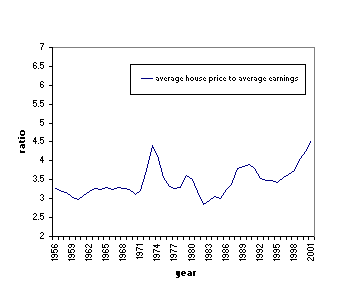
According to the Halifax Bank of Scotland House Price Index, the average house price in the United Kingdom as of January 2003 was £120,137. With average earnings in the United Kingdom standing at £27,379 (Office for National Statistics New Earnings Survey), average house prices are now almost 4.39 times average earnings. In some areas of the UK the multiple is much higher than this, in London for example, while in outlying areas of Scotland and Wales it is much lower. The following graph plots the ups and downs of the house price/earnings multiple through time and seems to indicate that the market is currently near a cyclical high.


Graph 1: Average UK House Price divided by UK Average Earnings
source: Halifax Bank of Scotland


The variability of the house price/earnings multiple does not of course reflect the performance of house prices themselves. Most people are well aware that average UK house prices have steadily increased for most of the last thirty years. Indeed, they have increased steadily over most of the last three hundred years. The following graph depicts recent growth in average UK house prices.


Graph 2: Average UK House Prices
source: Halifax Bank of Scotland


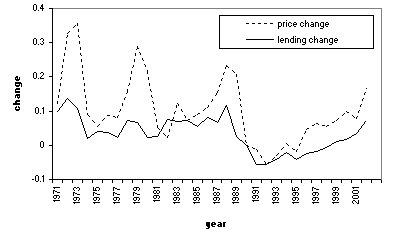
Those acquainted with the nature of the modern monetary system will be aware that the consistent increase in house prices is largely due to the way in which banks and building societies as a whole create new money when making loans. Borrowers spend the newly created money on houses (as well as cars, holidays, clothes and other consumption items) and in due course this spending leads to general increases in price. If bank and building society lending (read "money creation") for property purchase increases sharply, a property boom usually results. Real factors that would otherwise affect the value of a house (quality of construction or location, for example) can be completely overshadowed by monetary factors under these circumstances. On the other hand, if lending for property purchases decreases, property prices tend to stop increasing or even decrease where the slow down in lending is severe. The following graph depicts the relationship between changes in bank lending for property purchase and changes in property prices.


Graph 3: Yearly House Price Changes versus Yearly Changes in Lending 1
source: Bank of England, Economist Publications, Halifax Bank of Scotland


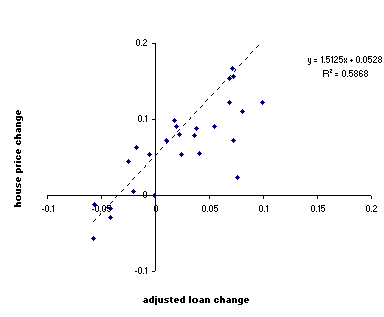
The same data can be plotted to show the relationship between price changes and lending changes, ignoring the element of time. The strength of the correlation between lending changes and house price changes is now clear (the r squared correlation coefficient is 0.5868):


Graph 4: Yearly House Price Changes plotted against corresponding Changes in Lending 1
source: derived from data in Graph 3


For individuals who buy houses using interest-bearing loans, the housing market can be a highly profitable place because, as lending institutions pump money into it, the price of houses increases but the debt that was borrowed in order to buy each house remains fixed in nominal terms. If house prices go up very fast the ratio of mortgage to house value can decrease very rapidly, thereby making the home owner richer in money terms should he or she wish to sell the house and repay the mortgage. Hence, many businessmen try to make profit by: a) borrowing money at interest; b) buying property; c) renting the property to a tenant for a while; d) selling the property; e) repaying the debt; and f) taking the surplus as profit. As long as the rental yield on a property plus the rate of price increase continues to exceed the rate of interest on the loan that was used to purchase the property, such businessmen continue to make profit.

For individuals who do not own property however, the situation is a rather grim one. Imagine that it takes ten years for an individual to save £50,000 towards a house that is today worth £50,000. With the constant increase in house prices, by the time that individual has saved the £50,000, the house might be worth £100,000 or more. In effect, the value of the individual's savings relative to house prices has been halved over time, which is another way of saying that house prices have doubled over the period. Ultimately, this devaluation has been caused largely by the manufacture of new amounts of money by the banks and building societies, for which reason their business has sometimes been regarded as a basic fraud upon society.

To summarise, the beneficiaries of the lending institutions' activity are firstly the lending institutions themselves (because they earn interest on their loans) and, secondly, property speculators (whose net assets increase during times of property price inflation). We should recognise too that many existing homeowners do not actually gain anything from increasing house prices. If I sell my house today and move to another house, price increases do not benefit me at all because although I sell my existing house more expensively than I bought it, I must also pay more for the next house that I purchase.

Against this background, Muslims in the United Kingdom need to make an important decision. Should they buy a house in order to get a foot on the property ladder, or should they rent? By buying a house the buyer protects the value of his or her hard earned savings in the long run as Graph 2 above shows. The alternative has, in the past, had distinct commercial disadvantages. In order to avoid the sin of borrowing at interest, some Muslim friends of mine in London have been renting since the 1960's when a four-bedroom house in Fulham cost £3000. Today, that same house can cost over £1,000,000. The Muslim tenant has paid far more in rent than he ever would have done had he bought the property on an interest-bearing mortgage, but the ironic thing is that the person from whom the Muslim is renting is often someone who actually did buy the house using an interest-bearing loan. That landlord not only collected all of the Muslim's rental payments, but also benefited from the house price increase from £3,000 up to £1,000,000. The landlord pays interest of course, but the total repayments on a £3,000 mortgage over the last 40 years would have been less than £15,000, which is not very much in the overall scheme of things. Under today's monetary system, the rental option seems to be commercially ill advised in the long run.

Nevertheless, there are advantages to renting which must not be overlooked. These include the ability to quickly leave a property and move somewhere else, freedom from maintenance worries, and the freedom from mortgage debt. For a sincere Muslim, the freedom from the sin of paying interest is of greater importance than all of these.

If a Muslim does wish to buy a residential property, and if he or she has decided that it is better to buy now than wait for a fall in house prices, the question now arises as to how to arrange finance. In this respect, and given that few are fortunate enough to have sufficient savings at their disposal, much of the Muslim community has been glad to hear of the recent appearance of Islamic mortgages in the UK market. It is widely believed that these financing schemes will finally allow Muslims to become part of the "property owning democracy", and escape the economic trap of long term rental. On account of this development UK lending institutions are of course very happy too, because the existence of an "Islamic" mortgage allows them to lend to a hitherto unexploited market, the Muslim market, and thereby make extra profits.

Having noted that Islamic home finance does not necessarily imply an Islamic mortgage (family and friends may not seek a mortgage on your property if they are the ones providing the loan), the following is a brief description of the three models of Islamic house financing currently in existence in the Western world generally, and in the United Kingdom specifically.

The murabahah model was first applied widely in the United Kingdom at the retail level by United Bank of Kuwait (now known as the Al-Ahli United Bank). Here, Person A (the bank) buys the house for £100,000 from Person B (the house seller) and immediately sells it on to Person C (the client and prospective homeowner) at a price of say £150,000 to be paid in equal installments over say 15 years. Person C must begin the process by promising Person A in writing that if Person A buys the house from Person B, then Person C will immediately buy the house from Person A. The shariah scholars who approve this transaction say that it is trading (buying and selling of houses), not lending at interest, and that it is therefore halal. Others point out that if banks are traders of houses then their stock in trade should be a portfolio of houses, just like every other property dealer, whereas in fact the stock in trade of a bank is money. No doubt the cynicism among some sections of the Muslim community is only increased when they see that the cash flows paid by the client to the bank are usually fixed from the outset of the transaction, just like the interest based alternatives. Viewed from the bank's perspective, as soon as the bank transfers £100,000 to Person B, the agreement with Person C automatically comes into effect requiring Person C to repay £150,000 to the bank at a later date. The transaction is therefore one of transferring money to Person B on condition that Person C repays a larger amount at a later date. Money now for more money later with the house in between, so to speak. Many bankers admit in private that this is an interest-bearing transaction, and indeed standard banking practice does not normally encompass anything other than an interest-bearing loan on the asset side of the bank's balance sheet. There have been exceptions to this rule, for example with the Shared Appreciation Mortgage issued by the Royal Bank of Scotland some years ago. Here, the bank's return was a share of the increase in the price of the property being financed. However, even in this case, the bank refused to share falls in the price of the property over time, and therefore fixed its minimum return on funds loaned at 0%.

Under the Ijara model, Person A (the bank) buys the property from Person B (the house seller) and rents it to Person C (the client). C pays A for the "use value" of living in the property, which most modern scholars see as an acceptable form of trade. The bank may agree at the outset of the Ijara to sell the house to the client at the end of the rental period, perhaps for a nominal sum of £1. Alternatively, the bank may require the client to pay regular amounts on account to the bank, and after an agreed amount of payments has been made the bank will transfer ownership of the house to the client. The Al Ahli Ijara model in the UK operates on the latter basis.

A number of Shariah problems relating to the above transactions have been discussed in recent years. In the Al Ahli Ijara model for example, rental levels are reset yearly in line with market interest rates. Although scholars have argued that this in itself is not haram (why shouldn't I make the same percentage of profit selling my lemonade as the chap next door makes selling his beer?) the fact is that the client does not know what rental he has contracted to pay to the bank until the beginning of each new year. If interest rates increase dramatically, then the Ijara rental rates will likewise increase, and the client could well find himself locked into the payment of lease rentals that he cannot afford. This is one basic reason that traditional scholars in Islam have made the specification of price a basic requirement of any sale contract. (How can I agree to buy something if I don't know the price?) Furthermore, if the client decides that he can no longer afford the rental, the Al Ahli contract requires that he must guarantee to repay the amount of finance initially provided by the bank. In those cases where the house has to be sold to achieve this, the possibility arises that, if property prices have fallen in the meantime, the sale proceeds may not be sufficient to repay the financed amount. In this case, the client is required to make up any shortfall to the bank, and the awful prospect of "negative equity" arises for the client ... a position in which the client owes more in debt than his house is worth.

Furthermore, conceptually, it should be obvious that the client can only be renting the property if he doesn't own it. Yet if the Al Ahli product really is a rental, why does the client have to bear the risk of a fall in the price of the property? On the other hand, if the client is bearing this risk because he owns the property, then why is he paying rental to the bank? Perhaps the case is that the client and the bank both own part of the property, but the Al Ahli contract makes it clear that the bank owns the house in its entirety until the final payment on account is made by the client, and only at that time will title be transferred to the client. The truth of the matter here is that the core Islamic contracts of sale and rental have been mixed together so that neither bears integrity any longer. The danger of such mixing should be obvious from a consideration of what would happen if an Islamic money lender was allowed to combine hiba (a gift) with qard (an interest-free loan) and a promise, all three of which are acceptable contracts in Islam. The money lenders' clients could then be asked to promise to give the money lender a gift upon repayment of any interest-free loan that he made to them. That would clearly be a case of interest, but the contract documents would never need to mention the word "interest".

The third model of home financing to be made available in the United Kingdom is the diminishing partnership model. This model has been tried and tested over many years in Canada by the Islamic Co-operative Housing Corporation Limited, and has been recently introduced into the UK by Ansar Finance in Manchester through Ansar Housing Ltd. Here, a prequalification period is required in which each client purchases shares in the house financing organisation in order to gain the right to apply for house financing at a later time. Funds raised by the organisation in this manner are used to finance other clients who have completed their prequalification periods. When the client has qualified for house financing, Person A (the house financing organisation) buys the house in its name from Person B (the house seller). Person C (the client) then becomes a partner of Person A in a nominal partnership vehicle which is deemed to own the property ("nominal" because the name of this partnership vehicle does not appear on the property's title deeds). For this purpose, Person C transfers the value of his prequalification shares in the organisation to the partnership vehicle, and the relative size of Person A's and Person C's contributions determine the ratio of their shares in the partnership. Person C now lives in the house and pays rent to the vehicle. The rent is then distributed among the shareholders of the vehicle, which of course include Person C himself. Over time, Person C buys Person A's shares in the vehicle and eventually comes to own all of them. At this stage he is the full nominal owner of the house and therefore pays all of the rental on the property to himself. The final formal step is then taken of transferring title in the property to the client, following the making of a special final payment (see next paragraph) between Person A and Person C.

The most common implementation of the diminishing partnership scheme is one in which the rental levels and the purchase price of each share is fixed at the outset of the contract (rather than being related to market values at each point in the future). Models in which the purchase price of the shares has to be made at a price reflecting the property's market value at the time of purchase have not been well received by potential clients. This is presumably because clients know that house prices tend to rise over time and, therefore, that it is not in their interest to pay a price that reflects the market value of the property each time they want to increase their holding of shares. The disadvantage of such fixing is that the people who invest in the organisation's shares are often those who are doing so in order to save the deposit for their own house. If the organisation's property assets are sold off piece by piece at prices that were agreed several years previously then, given that property prices tend to rise, those assets will tend to be sold at below market value. This of course is a rather poor commercial deal from the point of view of the scheme, and in turn for the savers whose money has financed it. The fairest deal is for each sale of shares to take place as close to market value as can be achieved with cost efficiency. To this end, the Ansar Finance product attempts to some degree to share gains or losses in the capital value of the house among the partners (in a pre-agreed ratio) when the nominal partnership comes to an end. This is the special final payment referred to above.

Three main commercial issues are currently the subject of attention in the UK Islamic mortgage market. Clients are concerned about the level of deposit that they need to muster before being accepted by the bank. HSBC's new Islamic mortgage product to be launched at earliest in July 2003 in the UK may require as little as 10% (of the property price) in down payment by the client, but the Al Ahli murabahah and ijara schemes currently require a minimum 20% deposit from the client (reduced to 17% or less for larger property values), and the Ansar Finance diminishing partnership scheme requires a 20% deposit following the prequalification period. This level of minimum deposit does not compete with those interest based lenders who offer 100% mortgages, although Muslims who remember the experiences of the late 1980's property boom would probably not see this as a bad thing. On the other hand, following the announcement by Chancellor Gordon Brown in his recent Budget, the problem of double stamp duty (paid by the bank as purchaser from the original seller, and then again by the client as purchaser from the bank) is set to be neutralised. To achieve this, the two house sale transactions that occur in murabahah, for example, will probably come to be seen as part of one financing agreement operated in accordance with Islamic principles and not as two unrelated sales. Thirdly, bankers are concerned about the Basle capital adequacy standards in which a higher capital asset weighting is given to property assets than to property loans secured by mortgages. This requires a bank to devote more of its risk capital to Islamic mortgages than to interest based mortgage loans, and this in turn tends to increase the costs of Islamic mortgages when compared to their conventional counterparts.

From a wider economic perspective, the promotion of Islamic mortgages brings with it a series of dangers that have hitherto been confined to the interest based domain. Not least among these is that if Muslims start borrowing in earnest from the banks and building societies, then the price inflation disease may hit their communities with the same force that it has hit other communities across the UK. For example, in Leicester's Highfields area, whereas £60,000 bought a standard three bed terraced house in early 2000, local Muslims have found that the purchase of a similar property can now cost £120,000 or more. Most Muslims now have little choice but to borrow from the bank in order to buy a house in Highfields, but the situation would never have arisen if house buyers had not started going to the bank to get loan finance in the first place. Those who sell up to move somewhere cheaper do benefit from the property price inflation in Highfields, but those Muslims moving in to the community must carry higher debt in order to live in the very same houses.

Although banks and building societies as a whole are creators of money, at the individual level each bank and building society funds itself by borrowing at one rate of interest and subsequently lending to borrowers at a higher rate. Likewise, most Islamic mortgages fix the lender's financial return on money invested from the outset. The fixing is either achieved by quoting an absolute rate (for example, the client pays 70% "profit" to the bank in a murabahah) or as a spread above the interest rate at which the bank is borrowing (for example, the client pays a rental rate equal to the London interbank offered rate, LIBOR, plus 1% per year to the bank). Generally speaking, a bank will only put £x into the transaction if it knows that it has simultaneously contracted to receive £x plus something in addition from its customer at a later date. My guess is that Al Ahli borrows one year money at LIBOR from the London interbank money market in order to fund its Ijara scheme. Every year Al Ahli renews its borrowing on the money market for a further year, which is why it insists that every year the rental rate under its ijara contract is reset to an amount equalling LIBOR plus a quoted margin. That margin is Al Ahli's profit, and the Al Ahli Ijara contract seeks to guarantee that margin from the outset. If interest rates in the UK rise sharply in future, perhaps due to the weakness of Sterling on the currency markets, many Ijara customers may find themselves in great difficulty. If repossession orders were then to become common, Islamic mortgages might come to be seen as no less threatening to the financial health of a household than the interest-based alternatives.

The market for Islamic mortgages is substantial enough to provide a lucrative niche for those organisations that establish themselves early, but the retarded pace of development may have more to do with the attitudes of the Muslim community than lethargy on the part of mainstream lending institutions. I remember promoting a market-value based diminishing partnership model in 1995 to a Muslim Housing Association in London, only for the director to announce rather proudly at the end of my presentation that "We don't need Islamic finance. We have just agreed a five year fixed rate loan from Barclays Bank, thanks be to Allah". It was the "thanks be to Allah" bit that really depressed me.

For some, asking the Bank of England to organise a working committee on Islamic mortgages is like asking the local thief to install a security alarm. For others, an interest based mortgage is a price that has to be paid for living in a non-Muslim country. What seems clear at the moment is that many Islamic mortgage products have cash-flows and default conditions that are dangerously similar to their conventional counterparts. The Muslim community ignores this fact at its peril. Interest-bearing debt is the antithesis of true freedom and, like a heavily indebted country, a heavily indebted man is at the mercy of his lender and paymaster. People with big mortgages tend not to upset the boss on a point of principle. Likewise, the growth of an Islamic mortgage culture may be a powerful force for assimilating Muslims into the wider UK society. Is this the strategy being played out now?

The overriding political fact is that Islam provides the last serious institutional challenge to modern usury. Issues decided in the world of Islamic finance today may determine whether that challenge succeeds in years to come. At its worst, failure could mean that Islamic finance becomes just another way for conventional institutions to practice usury.

Tarek El Diwany
April 2003

Sharia-compliant mortgages

Sharia-compliant mortgages

Muslim in front of a house with a SOLD sign displayed

Until recently, mortgages were a religious obstacle to any Muslim who wanted to buy a home. Muslims must be sure that the mortgage complies with Sharia (Islamic) law. The biggest problem for a British Muslim who wants to buy a house is that either paying or charging of interest is prohibited.

Most UK mortgages involve the house-buyer borrowing the money and paying it back with some interest charged on top. No good for Muslims. To avoid the issue of paying interest, Muslim mortgages usually involve the bank buying the property and then the buyer purchasing it from them and renting it over a length of time at a slightly increased price.

Muslim mortgages also involve making other aspects of the mortgage Sharia compliant, for instance making sure that the money the banks use to buy the property comes from permissible sources.

Until July 2002 only one financial institution in the UK offered Islamic mortgages (The United Bank of Kuwait). The shortage of Muslim mortgages was due to a combination of technical and cultural problems.

Stamp duty was one of the biggest problems. Stamp duty is a one-off tax that is charged on every property sold. But stamp duty was being charged twice on Islamic mortgages because in a Muslim mortgage the property is in theory bought twice (once by the bank and once by the buyer).

Banking institutions also lacked knowledge not only of Sharia, but also of the Muslim community itself, and this probably held up the development of Sharia compliant products. All financial products for Muslims must be checked by a panel of Muslim scholars, and bankers were not used to working with religious experts and were unfamiliar with the language of the Qur'an.

The law on stamp duty has been altered - double stamp duty was abolished on Islamic mortgages in April 2003 - and the government has been urging banks to work with Muslims. One of the first results came in July 2003 when HSBC, one of the biggest banks in the UK, brought out a range of Sharia-compliant mortgages. By the end of 2005 there were five banks offering islamic mortgages including, Lloyds TSB and the Islamic Bank of Britain.


Lloyds TSB launches Islamic mortgage

Adam Jay
Tuesday March 22, 2005
Guardian Unlimited


Lloyds TSB will launch a home finance product which is compliant with sharia law today, a month after introducing an Islamic current account.

The facility - an alternative to a traditional mortgage - conforms with Islamic law, which forbids both the payment and receipt of interest. Rather than lending money to a customer to buy a property, the bank buys a home for the customer, who then pays the purchase price in monthly instalments.

As the bank is the legal owner of the home, the customer also pays a monthly rent, which decreases as the customer buys the bank's share of the property. Eventually the customer buys out the bank, at which point ownership is transferred.

Mark Austin, of the bank's Islamic financial services division, claimed that the new facility will do away with the dilemma of having to go against one's faith or avoid a mortgage altogether.

"Our research tells us that three quarters of the country's Muslims want banking services that meet the needs of their religion, and this new home finance product should help bring a new generation of homeowners onto the property ladder," Mr Austin said.

Islamic mortgages have tended to cost more than standard ones, and have traditionally demanded a 30% deposit. However, competition has recently increased - with facilities now offered by institutions such as independent financial adviser Destini, and HSBC's Amanah Finance division. That competition has driven the required deposit lower - with both Amanah and now Lloyds TSB providing up to 90% of the purchase price.

Although the market is still relatively limited, mainstream banks have finally begun to wake up to the potential in offering sharia-based products to Britain's 1.8 million Muslims. Back in 2002 a report by market analyst Datamonitor estimated that sharia-compliant mortgages would be worth £4.5bn by next year.

Amanah also offers a pension fund which excludes shares in companies dealing in areas such as alcohol, gambling, pornography, pork products, tobacco or conventional financial services.

Lloyds TSB - which has consulted a board of Islamic scholars - will pilot the scheme at the five branches in London, Luton and Birmingham which have offered a sharia-compliant current account since last month.

The Ijara Mortgage

This is a slightly more popular choice of mortgage, as you do not need a large amount of capital behind you to set up this mortgage, it is also slightly more flexible than its counterpart. An extra benefit to this type of mortgage is that it can even be taken out to replace an existing interest mortgage. The amount you pay each month is usually fixed yearly. The outstanding balance can be paid off at any time (usually) without incurring any penalties.

So how does the Ijara Mortgage work?; As with the Murabaha mortgage, you find a property that you wish to buy, and agree a purchase price with the vendor, the difference is that; your lender will then purchase, and gain ownership of the property. You will enter into a lease agreement with the lender. Each month you will be expected to pay rent to your lender and a contribution towards the purchase of your property.

We advise that you shop around to find the right mortgage deal for you. If you have any further queries or for more information, fill out or quick enquiry form and speak to one of our advisors.

The Murabaha Mortgage


This is only really an option for individuals/families who have a fair amount of capital behind them, because it is a condition of this Mortgage package that you are expected to pay (circa.) 20% of your home’s value, on the day of purchase. However from that day the house will be registered as your own. You may pay off any debt that is outstanding on your home at any point. This package offers a fixed repayment period that is agreed between you and your lender, any a monthly repayment amount that is fixed for the term of your mortgage.

So how does the Murabaha Mortgage work?; When you find the house that you wish to buy, you arrange a sale price with the vendor as normal, however the bank pays the purchase price, then immediately sells the house to you at a higher price (the higher price is determined by the original price of the property, and the repayment period that you will have agreed with the lender), minus the percentage you pay as deposit.

Islamic Home Finance - An Overview

Islamic Home Finance - An Overview

Buying a home is most people's biggest financial commitment. It can be time-consuming, expensive and frustrating. To make matters worse, horror stories abound of gazumping, duff surveys and rogue estate agents.

You can make the process smoother by equiping yourself with the right information.

Islamic Home Finance - HSBC Amanah

Amanah Home Finance

Amanah Home Finance is based on the Diminishing Musharakah mode of financing and helps you buy your residential property without compromising your beliefs. If you already have a traditional interest based mortgage, the product allows you to refinance your property.

How it works

The Bank's interest will decline by the same proportion. The property will be leased to you for the financing term and you will pay rent.

You choose the property you want to buy and make an application. If you meet the criteria, financing will be agreed, then the following steps will take place:

Your solicitor or other legal adviser will be sent the legal documents, and will explain these to you.
If you then want to continue, you will be asked to sign the Amanah Home Finance letter. By doing this you will accept that the financing will be made available to you in accordance with the terms of the Amanah Home Finance letter. This means that the product terms and the obligation to enter into the associated documentation becomes binding at this time
Your solicitor or other legal adviser will make sure the title of the property is acceptable and approve the contract for the purchase of the property, ensuring that the contract to buy is capable of being transferred to us.
Contracts will be exchanged either with the person you are buying the property from, or you in the case of a refinance and a completion date agreed. This will be a binding contract for the purchase of the property. A date will be agreed for completion when the trust will be set up and the property leased to you.
At completion, the property will be held in trust by HSBC Trust Company for each of us in shares equal to our contribution to the purchase price, e.g. 10% for you if you have paid a 10% deposit and 90% for us if that is the amount of financing we have provided.
HSBC Trust Company as trustee will lease the property to you for the financing term. Our solicitor will register ownership of the property and the Trust Deed. Your solicitor or other legal adviser will register your ownership of tenancy in your name.

You'll need to make a monthly Amanah Home Finance payment to us for the term of your finance. The payments will be made on the 25th of every month, and will be collected from your account by Direct Debit. Your payment will comprise: rent, contribution payment and Charges, if applicable (any other sums payable for a leasehold property and buildings insurance if arranged by the bank).

For each monthly payment that you make you will pay the bank rent for the use of our share of the property and acquire an additional share for yourself. At the end of the agreed term, and when all payments have been made, you can exercise the promise to sell and we will transfer the property to you.

You can also purchase our interest in the property from us by exercising the promise to sell at anytime during the term of the finance.

Qualifying criteria

Suitable for those in permanent employment or the self-employed. UK national or foreign nationals with appropriate residency status.

Qualifying ages are 18-65 (70 ONLY with proof of income after retirement and at discretion ofApproval Manager - each case assessed on merit)

Credit check
Minimum deposit (10%)
Documentation required or information needed at hand for making an application are:

  • Proof of ID - Valid Passport
  • Proof of Address - Driving Licence withexisting address or a recently paid utility bill
  • Proof of Income - Last 3 months payslips orlast 3 years accounts arranged by a registered accountant
  • Proof of Affordability and Financial Competence - Last 3 months bankstatement.
  • Minimum deposit requirement
  • 10% for mortgages up to £299,000

Qualifying Property & Value

Qualifying Properties:

Freehold Domestic Residential Properties in England and Wales.
Leasehold Domestic Residential Properties, including flats and maisonettes. With an unexpired lease term minimum 50 years plus the term of the tenancy (subject to landlord's consent if required, for us to let the property to you).

Non Qualifying Properties:

  • Commercial Properties.
  • Properties outside England & Wales.
  • Buy to let properties.
  • Shared ownership.

Please note: Any offer of finance on qualifying properties will be subject to status and a satisfactory valuer's report.

£25,000 is the minimum amount of finance available through Amanah Home Finance and your chosen property must be valued at £28,000 or more.

Payment terms

Up to 30 years, or the age of 70.

Income Multiplier

Applicants can make one application - i.e. potentially 6 incomes cantaken into account when assessing an application. Salary multiples are not used but affordability calculated using customersearnings and outgoings.

Shariah panel / advisors

  • Justice (Retd) Muhammed Taqi Usmani
  • Shaikh Nizam Yaquby
  • Dr. Mohamed A. Elgari
  • Dr. Muhammed Imran Usmani

Islamic Mortgages - Alburaq Home Finance

Alburaq Home Finance

ABC International Bank (ABC) and Bristol & West plc offer you Alburaq – Islamic Home Finance. Then ABC International Bank and Bristol & West will provide all the technical expertise and support, plus the home finance itself. Alburaq Home Finance is based on the principles of Ijara and Diminishing Musharakah

Instead of lending money for a property, Bristol &West will buy the home, contributing up to 90 per cent of the purchase price. You will pay the remaining share and pay the outstanding sum over an agreed term, together with a rental payment.

Alburaq is a registered trade mark of ABC International Bank plc and is the brand name under which home finance product is provided.

How it works?

Alburaq offers:

  • First time buyer / home mover mortgages
  • Buy to let options (for up to 10 properties)
  • Self cert. options

Described simply, both you and the Bank will each contribute towards the purchase of the home. For example, the Bank may contribute 90% and you 10% of the purchase price. Over a period of up to 25 years, you will make monthly purchase instalments through which the Bank will sell its share (90%) of the home to you. With each payment instalment, the Bank’s share in the property diminishes while your share correspondingly increases. While the purchase instalments are being made, the Bank will charge you a rent for the use of its share of the property, the rent being calculated according to the respective shares owned:

Step 1 - You make an initial payment to Bristol & West of at least 10% of the property value. You sign two contracts, the Diminishing Musharakah contract and the Ijara contract. Then you promise to purchase the remaining 90% of the property over an agreed period and you agree to pay rent to Bristol and West.

Step 2 - Bristol & West contributes up to 90% of the property value and buys the property on your behalf

Step 3 - The property is then transferred to you from the seller.

Step 4 - The property deeds are transferred to Bristol & West.

Step 5 - When you have purchased the property completely, the property deeds are transferred to you.

Qualifying criteria

Minimum Age:

18 - Residential Standard

21 - Self Certification

As with any conventional property financing, the decision to fund the purchase of the property will be based on our belief in your ability to meet your payments. In reaching this decision, you will be required to provide certain information, some of which is contained in the application form, and the following will also be considered:

Your income and expenditure

How you have handled your financial affairs in the past
Information received about your financial affairs from, for example, credit reference agencies and any other "referees" which you may provide
Credit assessment techniques which take all your personal details and establish your creditworthiness
Your age
The nature of the property and its condition.
Minimum deposit requirement

RESIDENTIAL APPLICATIONS:

£15,001 - £500,000: 90% of the value of the property
£500,001 - £1,000,000: 75% of the value of the property
£1,000,001 - £2,000,000: 70% of the value of the property
Above £2,000,000: Please contact us.

SELF CERTIFICATION APPLICATIONS:

£25,001 - £500,000: 85% of the value of the property
Exceptions to the above criteria will be looked at by Bristol & West on an individual basis.

Qualifying Property & Value

Minimum finance amount is £15,001 for purchases and £25,001 for refinances
Purchase a freehold or a leasehold flat or house (subject to a minimum lease length of 70 years)
The maximum finance allowed for individual properties is £400,000, being up to 85% of the property value
The maximum finance allowed for individual properties is £500,000, being up to 75% of the property value
Multiple properties/ portfolios are allowable; The rent you charge your tenant must be at least 115% of the rental payment you must pay each month; The property must have a value of £40,000 or more
A basic valuation is required. In addition, the Valuer will evaluate the ease of letting the property and provide an estimate of the likely income from renting the property unfurnished.

Payment terms

You can take Islamic Home Finance for between 7 and 25 years. And you can pay off the balance of the purchase price from Bristol & West at any time.

Income Multiplier

Where 1 applicant has gross income* of at least £20,000:

4.0 x main + 1 or 3.25 x joint

Where gross income* is less than £20,000:

3.5 x main + 1 or 2.75 x joint

Residential Applications - Self Employed allowable income will normally be calculated as an average of the last 2 years Net Profit shown in the Accounts, subject to stable/ increasing Net Profit levels.

Self - Certification Applications - Employed applicants must have held employment for 6 months, Self Employed applicants must have traded for a minimum of 12 months.

Shariah panel / advisors

  • Shaikh Nizam Yaquby (Chair)
  • Mufti Abdul Kadir Barkatullah
  • Mufti Muhammad Nurullah Shikder

Islamic Mortgages - Manzil Home Purchase Plans

Manzil Home Purchase Plans
Manzil differs from a conventional 'interest' mortgage because we are able to provide financial help without our clients having to pay us interest. We can do this by employing the Ijarah method of Islamic Finance.

How it works?

Ijara

Under Ijara the bank will buy and own your chosen property.

We then sell it to you for the same price with payment spread over a period of up to 25 years.

While you are buying the property from the bank we will also charge you rent for living in a property we own.

The bank therefore makes its profit from the rent we receive from you and, once you have paid us the full purchase price, the property will become yours.

The bank therefore makes its profit from the higher sale price of the property.

Qualifying criteria

Suitable for those in permanent employment or the self-employed. Who are able to pay the purchase price before the age of 65. Minimum age 18.

  • Bank statements
  • Credit check
  • Employment status check
  • Minimum deposit.
  • Minimum deposit requirement
  • 20% of property value up to £100,000.

17% of property value £100,000 to £250,000 (max 17%).

25% of property value for Non-UK residents, for applicants working aboard, or for buy-to-let properties.

Qualifying Property & Value
All types of residential property, owner occupied property considered in England & Wales.

Minimum lease term; 40 years-unexpired in excess of the payment period (currently excluding right to buy).

Minimum property value - £50,000 (residential)

Minimum finance amount - £40,000

Buy to let property value - £100,000

Minimum finance amount - £60,000

Payment terms
Ijara - up to 25 years, minimum term 7.5 years.

Max 15 years for non-UK residents

Income Multiplier
3 times primary annual income (sole applicants).

3 times the higher income plus 1 times the lower income or 2.5 times combined income for joint applicants, however, we will look at each case on its own merits.

Shariah panel / advisors

  • Shaikh Nizam Yaquby
  • Justice (Retd) Muhammed Taqi Usmani

Islamic Mortgages - United National Bank

Islamic Mortgage

UNB IslamicMortgage is a diminishing ownership product that is based on Ijara principles. The amount paid by the customer results in the customer’s beneficial interest the property increasing.

United National Bank is a UK registered bank that is authorised and regulated by the Financial Services Authority (FSA).

How it works?
You will have to complete the mortgage application form. UNB will use this to consider your application.

Once UNB is satisfied that you have fulfilled their criteria they will send you an offer letter. This will describe the offer terms.

On completion we will pay the amount UNB is willing to pay towards the purchase of the property to your solicitor. You will pay the difference between this amount and the actual purchase price of the property. UNB will be registered at HM Land registry as the legal owner of the property.

You will lease the property from UNB for an agreed number of years. You will pay monthly instalments towards the sale price of the property as well as rent for the duration of the mortgage term. And once you have paid the sale price and the rent due to UNB the property will be transferred into your name.

Qualifying criteria
Suitable for those in permanent employment or the self-employed. Who are able to pay the purchase price before the age of 65. Minimum age 18.

  • Credit check
  • Bank statements
  • Employment status check
  • Minimum deposit
  • UK national or foreign nationals with appropriate residency status.
  • Minimum deposit requirement20%

Qualifying Property & Value
All types of residential property, owner occupied property considered in England, Scotland, & Wales.

Other properties are subject to Bank approval.

Minimum value subject to Bank approval.

Payment terms
25 years.

Income Multiplier
3 times primary annual income (sole applicants).

3 times the higher income plus 1 times the lower income or 2.5 times combined income for joint applicants.

Shariah panel / advisors

  • Mufti Abdul Kadir Barkatullah
  • Dr. Muhammad Imran Usmani

Islamic Mortgages - What is Shariah

Shariah

Shariah is the term used to describe Islamic law. Riba ( interest ) - the abolition of interest, is a religious goal and value that the Islamic economic system is based on. Historically, the issue of Riba combined with limited availability of Halal mortgage options has prevented numerous Muslims from purchasing homes without compromising their beliefs.


Conventional mortgage loans are interest-bearing, in conflict with Islamic Principles, and therefore Haram (prohibited) by Shariah. This has presented difficulties for the finance industry and created barriers to homeownership for UK Muslims.

With the introduction of Halal (permissible) mortgages in the UK finance market, dedicated Muslims can now have a choice. They can purchase homes or refinance existing mortgages using faith-based options. Halal mortgages are structured differently than conventional interest bearing mortgages, so they are Shariah compliant and are inline with Islamic principles.

The two most common forms of Shariah compliant home purchase finance are Ijara and Musharaka. According to practitioners of Islamic banking and scholars, these methods are the most suitable means for purchasing property in the UK. Both Ijara and Musharaka are long established Islamic financing principles.

Ijara is based on a “lease-to-own” concept and is interest-free making it compliant with the Riba provision of Shariah. In an Ijara based transaction, you identify the property you wish to buy and agree to the purchase price with the seller. The bank enters into a “Promise to Purchase” agreement with you for an amount equal to the original purchase price and purchases the property. At the same time, you enter into a lease agreement with the bank which details your rights to occupy the property. You make monthly payments to the bank and a portion of the payment is applied toward the purchase of the property with the remainder paid to the bank as rent. Once the purchase price is paid in full, rental payments cease and ownership of the property is transferred to you.

Musharaka is based on a “shared ownership” concept. In a Musharaka based mortgage transaction, you identify the property you wish to buy and agree to a purchase price with the seller. The bank buys the property and leases it to you (similiar to Ijara). Your first payment is your initial contribution (deposit), in a Musharaka arrangement this amount will become your initial `Share` of the property. As the mortgage term progresses, the capital portion of your monthly repayment to the bank will add to your percentage share of the property. When you make your last payment at the end of the mortgage term, you would have purchased 100% share of your home.

Using the Islamic Finance concepts of Ijara or Musharaka, you now have a choice of faith-based mortgage options enabling you to purchase a home or refinance a conventional mortgage through a Halal mortgage which is Riba free and; therefore, Shariah compliant

Islamic Mortgages - What is Islamic Mortgage

It is against Islamic law to pay or receive interest, this has been a huge problem for Muslims living in Britain. When it came to home buying it was only the very rich, who could afford to buy a home outright. Fortunately however many banks and building societies are starting to recognise this as a problem and are offering an alternative.

There are two options available to you that correspond with Muslim law:

• The Murabaha (Deferred sale finance) Mortgage
• The Ijara (lease to own) Mortgage

The Murabaha Mortgage:

This is only really an option for individuals/families who have a fair amount of capital behind them, because it is a condition of this Mortgage package that you are expected to pay (circa.) 20% of your home’s value, on the day of purchase. However from that day the house will be registered as your own. You may pay off any debt that is outstanding on your home at any point. This package offers a fixed repayment period that is agreed between you and your lender, any a monthly repayment amount that is fixed for the term of your mortgage.

So how does the Murabaha Mortgage work?; When you find the house that you wish to buy, you arrange a sale price with the vendor as normal, however the bank pays the purchase price, then immediately sells the house to you at a higher price (the higher price is determined by the original price of the property, and the repayment period that you will have agreed with the lender), minus the percentage you pay as deposit.

The Ijara Mortgage:

This is a slightly more popular choice of mortgage, as you do not need a large amount of capital behind you to set up this mortgage, it is also slightly more flexible than its counterpart. An extra benefit to this type of mortgage is that it can even be taken out to replace an existing interest mortgage. The amount you pay each month is usually fixed yearly. The outstanding balance can be paid off at any time (usually) without incurring any penalties.

So how does the Ijara Mortgage work?; As with the Murabaha mortgage, you find a property that you wish to buy, and agree a purchase price with the vendor, the difference is that; your lender will then purchase, and gain ownership of the property. You will enter into a lease agreement with the lender. Each month you will be expected to pay rent to your lender and a contribution towards the purchase of your property.